
✘ Practice through performance: A tale of 3 jam sessions
And: Improvisation; How to overcome jam anxiety; Sitting in without getting kicked out

People often say the best way to practice your instrument is by playing in a live setting. It’s a sort of jumping-into-the-deep-end method: Instead of working through the math of playing softly along to a metronome at home, you could go for the jugular from the get-go and gain experience on the frontline. This way you get to see reactions from your bandmates and the audience in real time and figure out what works and what doesn’t in practice (no pun intended). However, the arguments against this method usually tackle the matter of preparedness – Are you actually capable enough to participate? Would you be able to carry a performance well enough for it to be enjoyable? Where does the line cross between voicing your artistic character and fitting in with a band in an improvised setting? As a player who often asks himself what the best practice methods are, I wondered how much of it is enough to make one ready for the stage. After attending three different jam sessions recently, I had some thoughts on exercising self-expression with strangers.
Nights on the town(s)
The first jam was at a small club in Utrecht, where a weekly session takes place every Thursday. This is the sort of student-oriented jam session where people around 10 years my junior tend to frequent, and the jump between jamming over covers and improvising a performance from scratch happens regularly. Something about it made me feel disoriented and somewhat out of my element, even though we never played anything too technically demanding; it was mostly funk-style grooves and going back and forth between two chords, yet it still made me leave the stage feeling somewhat empty inside. It’s as if I couldn’t really feel comfortable on the stage, so I’d say it’s mainly a matter of personal focus that was missing for me.
The second jam was the least conventional one in terms of genres. It was an avant-garde evening in Amsterdam where groups of individuals were called to the stage at random. This type of jam session has no clear genre that grounds each group into a specific set of rules. Surely enough, people were playing overtones on upright basses for full minutes, different rhythms were going off all at the same time, vocalists were scatting at stark dynamic ranges, and the like. I find these types of gatherings to be technically refreshing, as the performers are encouraged to play by no rules other than the ones of communication (or miscommunication) with each other.
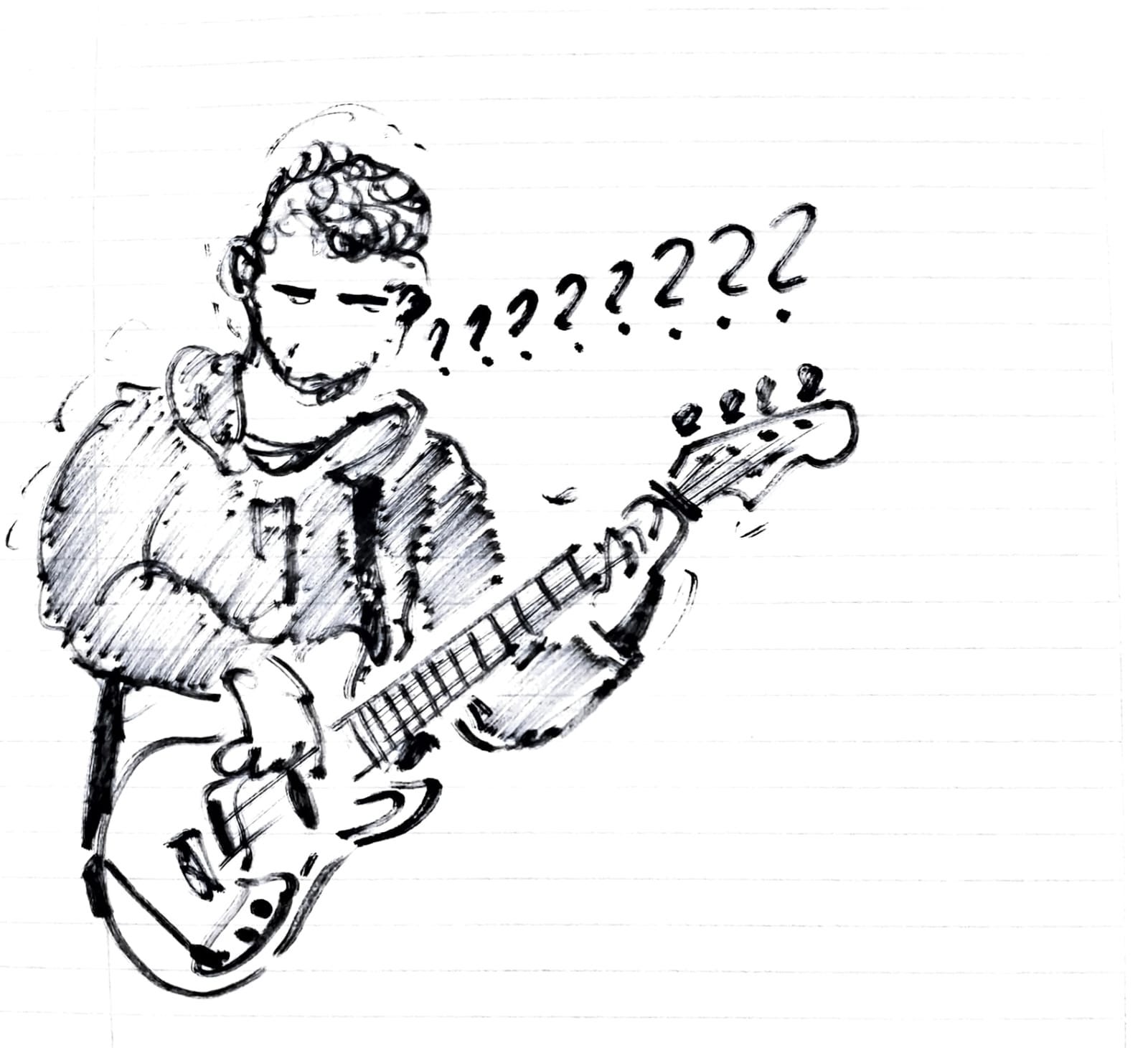
The third jam was a blues jam. It’s the sort of platform that’s perfect as a common ground for players to go off and try different arrangements since each performance is centered around the same three-chord progression: There were slow grooves, jump blues cuts, and even a few early Fleetwood Mac covers thrown in. The crowd is young, the venue is cozy yet central, and the camaraderie is there. However, I found this jam to be more of a test for my technical capabilities when I was thrown in the spotlight to play a bass solo. I do not play solos. So, while the overall evening was enjoyable, I felt haunted by my awkwardly thrashing about on my bass while at the same time trying to figure out whether my environment is appreciating it, or whether they would have preferred to go out for a smoke right then and there. While I do tend to self-criticize to a painful degree, something about it felt off.
Why go to jam sessions
Plenty of musicians spend years and years trying to figure out their respective artistic identities, myself included. Over time, we practice different exercises, transcribe songs or even whole albums, look up to influential figures for guidance, and repeat these processes like mantras. People who take it past the point of playing as a personal hobby will go as far as joining a band, and some lucky ones may manage to eventually make a living out of it. With jam sessions like these, I find that they’re the perfect test to one’s capabilities: To be put in a spot with strangers, and an audience on top of that, is the perfect testing ground for a musician’s technical and creative tendencies. With no preparation, and with spontaneity and chemistry as the only guiding lines we have, the environment is presented with us in our purest form. This is an opportunity to prove to ourselves where our time spent fine-tuning our craft has gotten us.
Another aspect in favor of participating in jam sessions is one of community-building and networking. New ideas, friendships, and collaborations often emerge from unplanned situations. For certain musicians, the craft itself proves to be the strongest glue in connecting with new partners, sometimes even over personal relationships. Being thrown into that deep end with others assures that our “survival instinct” will kick in, from which strong connections may be forged.
Getting through the deep end
The downside of an ill-matched jam session, or even the frequent slip-ups one may notice in the spontaneous nature of it all, is the appearance of performance mistakes. My clever partner, who attended the first evening with me, heard of my struggles with it in real time. However, not only did she enjoy the performance (objectively speaking, I hope), but she was also the one who pointed out to the aspect of mistakes as an inherent part of jam sessions. Of course, when practicing, we are not meant to play “perfectly” as we are when performing or recording. Rather, it’s the designated setting where mistakes must be acknowledged and worked over. Surely, there must be some control on the overall sound and meaning of the music being played; people mustn’t go on stage and bash the drums if they’ve never played drums in their life. Through all this, I’ve found that a good jam session could act as super fertile ground for personal and mutual artistic growth.
To each their own, though
Looking wider at these thoughts, I would like to stress out the importance of conventional at-home practice: If it works for you as a musician, then by all means, practice on and on. After all, there really is no one “true” way to practice; each musician may find their own personal and most gratifying method of going at it. Some may benefit the most from playing along to a metronome by themselves, some may prefer to go out to a jam session and “get a piece of the action,” and some do a healthy amount of both. My conclusion from this experience would be to remind everyone to be considerate and make space for whoever else is involved in your practice. After all, even the most flawless playing you’ve ever seen was meticulously carved from marble in some way or another, and over a considerable period of time. It’s really up to you to find your own way to do the same. Just remember to enjoy the view while you’re on the road.
LINKS
🕰 Improvisation: Thinking and playing music (David Beckstead)
“So how can it be that an essential element of musical expression and performance, one practiced by musicians in countless cultures and idioms for thousands of years, has been relegated to a single genre of music and associated with such anxiety?”
✘ An investigation into the relationship between improvisation practices and brain activity that ultimately encourages the integration of these methods into the classroom.
⏳ How to overcome jam anxiety (Celeste Johnson)
“Jams require you to put yourself out there, be vulnerable, and accept imperfections.”
✘ A breakdown of jam-related fears and anxieties often shared by musicians that also suggests ways in which these issues can be overcome.
⏰ Sitting in without getting kicked out: Navigating the jam session (Charles Wiley)
“It doesn’t take too long before you realize what needs to be improved in your playing when you are going purely on instinct, without the luxury of a rehearsal to start with beforehand. But for me (and a lot of musicians), that’s the fun part!”
✘ More jam session testimonies and the etiquette surrounding them, with important insight on how they present us with a learning experience.
MUSIC
I’m still surprised by how many people were never aware of Fleetwood Mac’s early incarnation, which was founded and spearheaded by revered British-blues guitarist Peter Green in 1967. “Rattlesnake Shake” was one of the covers performed by us during the blues jam, and I’m so glad to have been reminded of what a fun song it is.