
✘ Capturing Community
And: Sleep Token treasure hunt; Live Nation results driven by stadium tours; Spotify North American subscriber growth problems

What do we talk about when we talk about community? We’ve previously written about community as a dirty word and how community isn’t a new thing. Bas has called the 2020s the decade of community. I’ve previously introduced Minimum Viable Community thinking as well. Since we’re now a few years on from these pieces, it’s time to revisit community and think about how we can capture it.
Community building strategies
When we talk about community, we’re really talking about participation, not consumption. Communities emerge when people communicate directly with each other in shared contexts, when they say “I’m a part of this” rather than simply “I like this.” It’s the difference between simply showcasing fandom and attending multiple concerts or showing up to a Discord server every day. It’s all an experience, but community involved a different kind of commitment. What binds communities together isn’t just shared interest, but shared purpose—something that in fandoms often extends into identity itself. You’re not just listening to the music. You’re becoming a part of the story around it.
This kind of engagement is fundamentally reciprocal and self-directed. People within communities engage each other directly, in spaces they’ve often helped shape themselves. They don’t wait for the artist or platform to facilitate every interaction. Instead, people create their own rituals, inside jokes, collaborative projects. This is where co-creation happens: fan edits, cover songs, theories, zines, memes, events. The community becomes a generative and immersive space, not just a receptive one.
There is, however, a constraint that shapes everything: community participation is high-effort, which means people can only truly be active in a limited number of communities at once. You just can’t be everywhere. This dearth of attention and energy is why genuine communities are so valuable. Building a community means that you’re asking for more than fandom, you’re asking for a meaningful portion of people’s lives.
What’s the problem we tackle through community?
Social media promises connection but delivers something lonelier: an endless scroll where everything revolves around YOU. Your feed, your likes, your metrics, your anxiety about whether anyone’s paying attention. We lean back and let the algorithm wash over us, but this passivity rarely actually satisfies. The real pleasure comes from leaning in—from active participation, from effort that generates meaning rather than just consuming content that generates data.

Community offers something fundamentally different: it connects us with people who actually value what we make and create. Not in the abstract like-hitting sense, but in the tangible sense of having showed up, responded, and the feeling of having built something. These are the people who see your work and want to engage with it, remix it, talk about it, keep it alive beyond the short lifecycle of a social post. Community members do more than just appreciate your output. They become part of your creative process.
The stakes here run deeper than we sometimes acknowledge. We live in a phase of the digital revolution where platforms have turned us into products, packaging our attention, our data, our identities for sale to advertisers. Community becomes a moat against this productization of the individual. When you cultivate genuine community, you create space that exists outside the algorithmic extraction machine—space where people gather for reasons beyond what can be monetized, measured, or optimized. Quite simply put, you reclaim agency over how you connect and create.
Fans exist on a spectrum
Fans exist on a spectrum of engagement, and understanding this gradient matters more than chasing raw numbers. At the base, you find casual fans—general listeners who might stream your music occasionally but hold no deeper investment. Move up a layer and you encounter influencers: people who genuinely like what you do and feel compelled to evangelize it to others. Tinkerers want to interact with your work in different ways—remixing, covering, creating fan art, diving into the lore. Then come proprietary fans, primed for ownership rather than mere consumption; they want stakes in what you’re building. At the apex sit the superfans: roughly 100 true believers who care deeply about your work and actively seek exclusivity and meaningful access to your creative world.
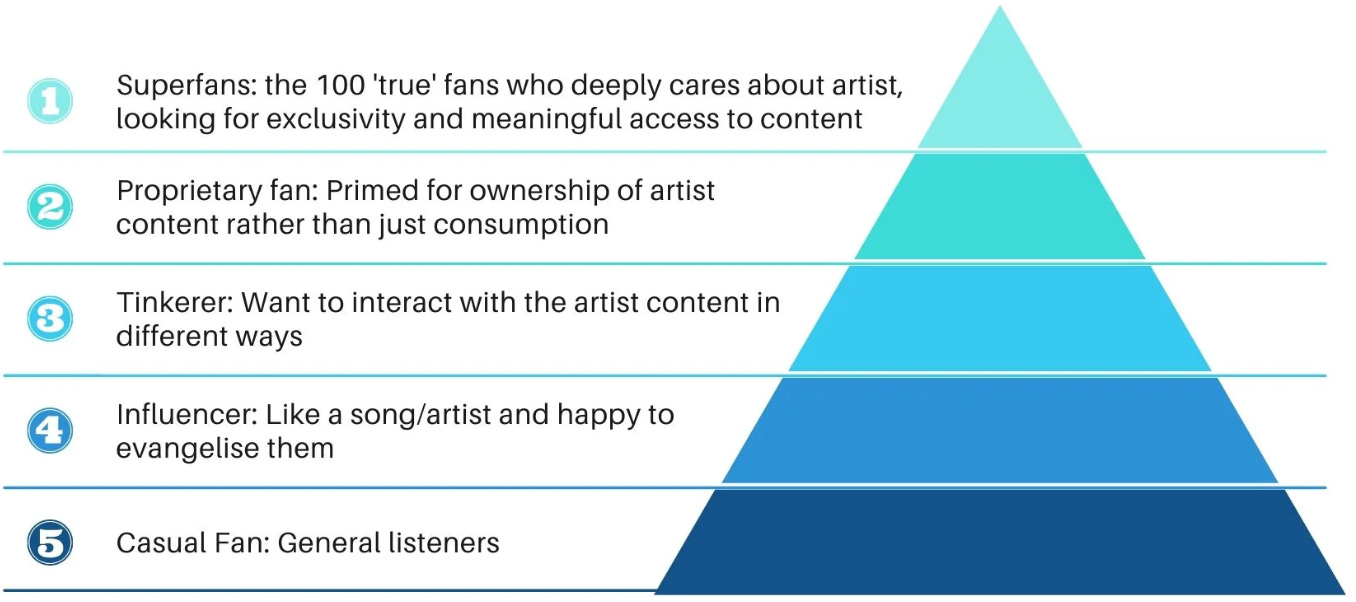
There are many of these theories, from Kevin Kelly’s 1000 true fan theory to Li Jin’s adaptation to 100 cult fans. There is, however, a fatal flaw in these theories. While fans indeed exist on a spectrum, the theories purport a linear flow from bottom to top. Like a funnel in marketing. People, thankfully, tend to move back and forth throughout this spectrum.
What this learning means is that when you build community, it starts with recognizing that fans exist as distinct groups with different needs, wants, and capacities for engagement. Morevoer, they require different spaces, different access, different value propositions. Create these spaces deliberately. For example, social media for broadcast and discovery, Discord or WhatsApp for deeper conversation, and crucially, IRL gatherings at concerts, festivals, or dedicated meeting spots where digital relationships can materialize into something tangible. Each space serves a different function in the ecosystem you’re building.
Set clear boundaries from the start · especially around monetization. People need to understand how value flows between you and them, what they’re paying for, and why. Then optimize those flows to match the spectrum of engagement depending on where they sit in your community. But don’t reduce everything to transactions. Create experiences that transcend commerce. This could be about discovery mechanisms around concerts, surprise collaborations, or moments that reward participation beyond what money can buy. The goal isn’t just to extract value from fans at different levels. The goal to give each level a reason to lean in further and allow them to lean back when they need to.
What a community strategy should do
Every community strategy begins with story. This is the story of the core team building the community, the narrative that draws people in and gives them something to orient around. Once people arrive, you need to focus on developing the community itself. Nurture the infrastructure, rituals, and interconnections that support the whole ecosystem. No community has ever emerged accidentally. It requires deliberate architecture: spaces where people can connect with each other and where those connections create a web of relationships resilient enough to sustain itself.
In our fragmented attention economy, you need to leverage every available tool to cut through the noise and create immersive experiences that pull people deeper into the story. Make people feel like participants rather than spectators, like they’re shaping the narrative alongside you. Crucially, find ways to create, sustain, and showcase social capital within your community. Recognition matters. When someone contributes meaningfully, that contribution should be visible and valued. Social capital becomes currency that motivates ongoing participation and rewards the most engaged members.
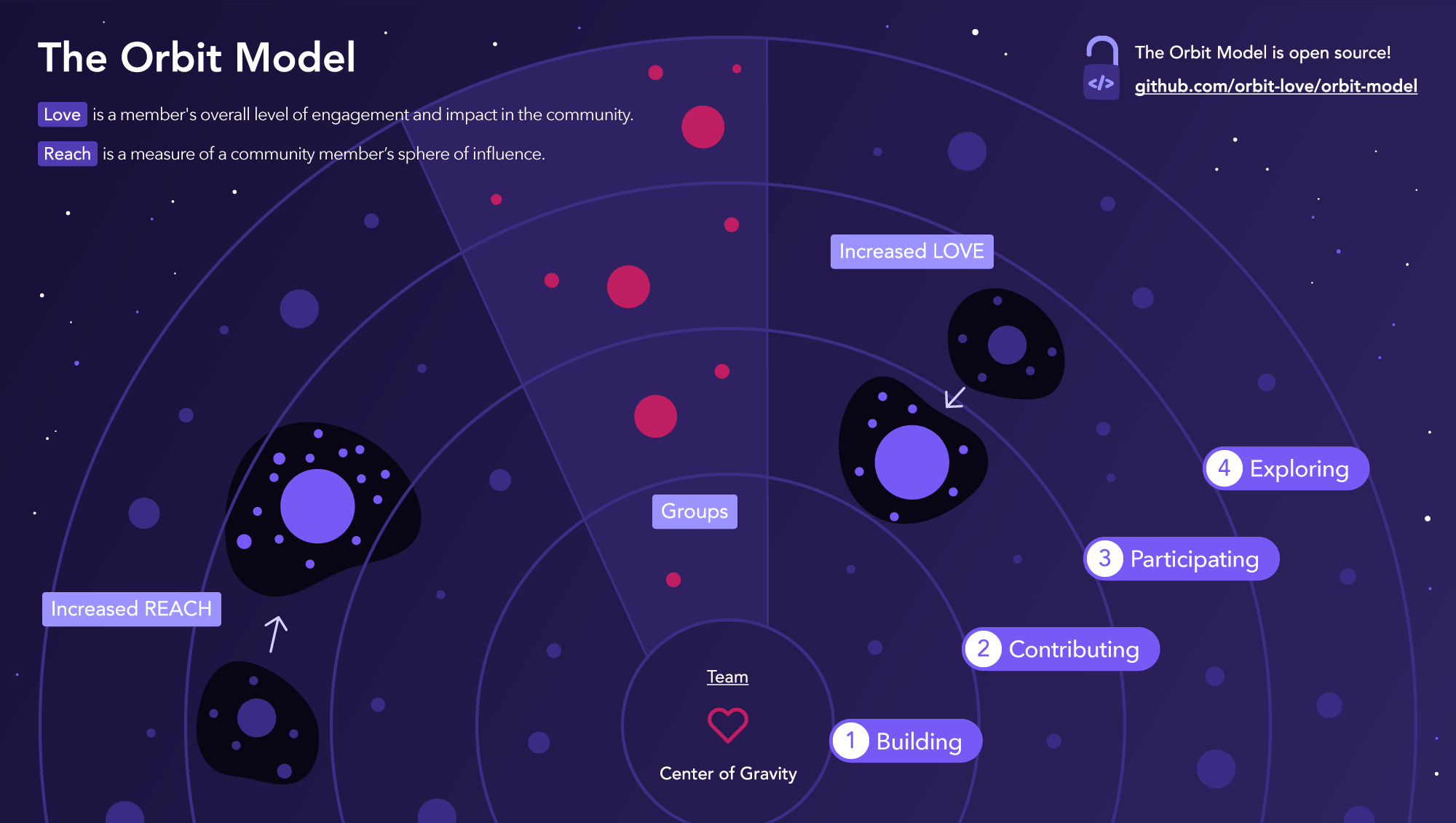
Healthy communities spawn subcultures. Allow people to break off into smaller squads within the broader ecosystem. This is the minimum viable community thinking that allows affinity groups formed around shared interests, locations, or creative approaches. These micro-communities strengthen rather than fragment the whole. They give people intimate spaces where they can form closer bonds while still feeling connected to the larger movement. The best communities aren’t monoliths. Instead, they’re constellations of smaller groups orbiting around a shared center of gravity.
LINKS
🪙 Sleep Token superfans got a lore-packed treasure hunt on recent tour (Stuart Dredge)
“Fans get their rewards, but so do Sleep Token and their label. The treasure hunt is helping them to collect data on fans who were physically at the concert venues, and who actively chose to engage with the activation.”
✘ A great example of the give-and-get needed in community building.
📈 Live Nation’s revenue jumps 11% to record $8.5bn in Q3 on strong stadium activity, fan spending (Mandy Dalugdag)
“Live Nation’s Q3 results also show that fan spending onsite remains robust, with amphitheater spending up 8% year-to-date and major festival spending up 6%. Venue Nation’s investments in hospitality continued to deliver strong returns, with newly refurbished venues showing significant per-fan spending growth.”
✘ The fact that revenues are driven by major stadium tours tells us that at the lower rungs, life is much more difficult.
🌎 Spotify’s North American Subscriber Growth Remains Sluggish Ahead of Anticipated Price Increases — Is a Less-Restrictive Free Tier About to Become a Big Problem? (Dylan Smith)
“Far from being unaware of the likely outcome, execs are presumably preparing to capitalize on it en route to righting the advertising ship. And those efforts, which will look to reverse the continued advert-revenue declines that have accompanied huge user additions and global ad-spending growth, are a different discussion altogether.”
✘ Whether Spotify will at some point find the key to cracking the advertising code is a big unknown.
MUSIC
I’ve been listening to Jon Porras’ new record Achlys and find it to be a beautiful concoction at the intersection of organic and electronic music.