

Author’s note: Parts of this series were initially published by Association for Electronic Music (AFEM) in November of 2025. The series was updated recently to reflect a greater interest in music remixes, especially given the news that Universal Music Group will open up their catalog to Spotify users so that they may make their own remixes of songs from that catalog within the Spotify platform. This update also includes the latest Luminate data and other industry developments.
If YOU have a vested interest in how remixes are merchandised and marketed in the world of music retail and streaming, please feel free to take the following survey. This industry survey is designed for Artists / Producers, and those who work on releasing remixes e.g. Record Labels, delivering remixes to DSPs e.g. Distributors, and merchandising remixes at DSPs e.g. DSP Editorial Staff.
Part 1 - Overview
Please use the links to jump to any section of this post that most interest you.
Enabling fans and casual listeners to create their own remixes
Conclusion and Part 2 preview: How music services struggle with remixes
Introduction
Electronic / Dance music is the 6th most streamed genre in the US according to Luminate’s 2025 Year End Music report with 51.3 billion streams of tracks that fall in the genre in 2025. In this series, I reveal that official remixes that fall within the genre can account from anywhere to 30%-50% of the catalog of Electronic / Dance music artists. Therefore I think it’s important to detail for the Electronic / Dance industry how remixes are being defined, marketed, merchandised and consumed.
The goals of this series are to:
Educate music fans on where they can find remixes produced by their favorite electronic / dance music artists, and help them determine what an “official remix” is versus an “unofficial remix”
Explain the artistry and business of electronic / dance music remixes to the larger music industry
Reveal for remix producers (and the record labels and management firms supporting them) what they can expect from streaming services and retail music sites in terms merchandising and streaming / sales analytics related to their remixes
A scoreboard detailing how each streaming and retail service handles official remixes
In part 1 of the series, I define what an “Official Remix” is versus an “Unofficial Remix” and the importance of “Official Remixes” in the music market. I also give a brief overview on how streaming services like Apple Music and Spotify present “Official Remixes” to their listeners. I am currently the label manager for the artist driven and Electronic / Dance oriented record label Soul Clap Records and an artist leading the dance music project FSQ. With remixes being a big part of both the label and FSQ, I have an informed perspective on how remixes are handled within the world of streaming and music retail.
What is an “Official Remix”?
When I write “Official Remixes” I am specifically referring to officially sanctioned remixes where the original Artist A “The Original Artist” has employed Artist B to remix Artist A’s original track. To be considered officially sanctioned, Artist B, “The Remixer” will typically be paid a work for hire “remix fee”, and / or be granted a % of recording revenues generated by the remix (from download purchases and streams). In some cases, the remix will be registered as a new work in the world of music publishing, with the remixer getting a % share of writers and / or publishing share on the new work. There are instances where the remix artist made an unsanctioned remix and presented it to Artist A and their label, and the remix was licensed by these parties officially after its production by the remix artist. Sometimes an unofficial remix will take off as a sound used on TikTok and Instagram and be used in millions of social media posts, at which point the label might want to monetize the unofficial remix by working out an agreement with the remixer to make it an officially sanctioned remix.
When it comes to remix artists collecting revenue streams, they can be tallied with royalty accounting systems that automate the % splits between Artist A and The Remixer for both recording revenues and performance, mechanical royalties and neighboring rights related to the remixes.
Official remixes count for much of the music streaming activity within the Electronic / Dance genre
For established commercial dance artists (e.g., Calvin Harris, David Guetta, Tiësto), remixes they have produced typically account for 15–30% of their total streams.
For mid-tier and underground artists, remixes they have produced can represent 30–50% of their total streams, especially when they collaborate with more prominent names.
For remix-heavy artists, such as DJs and producers who specialize in remixes (e.g., Meduza, R3HAB), more than 50% of total streams may come from remixed works.
Unofficial remixes and SoundCloud, YouTube, Bandcamp
I specifically made the declaration that what I am writing here is about “Official Remixes” because I do not expect DSPs to allow the distribution of the thousands of unofficial remixes nor market them to listeners. If that was the case, DSPs would be flooded with remixes indistinguishable from music officially licensed by original artists. SoundCloud and YouTube are two sites that have a great deal of unofficial remixes. Many Bandcamp artists and labels supply unofficial remixes for direct to fan retail, e.g. paid downloads, without the permission of the artists’ who created the original works which creates a copyright infringement situation and lost revenue opportunities for the original artists who produced the tracks on which the remixes are based.
For many artists within Electronic / Dance, a flood of unsanctioned remixes of their tracks can actually help generate the success for their original track given that each unofficial remix can extend the audience reach of their original track title and the underlying original music. It would be up to the original artist to determine if they want to pursue takedown requests of these unsanctioned remixes and if they feel they are detrimental to their artist brand.
Enabling fans and casual listeners to create their own remixes
Universal Music Group and Spotify recently announced that they will allow Spotify subscribers to use an AI tool to remix songs from within the Universal Music Group catalog within the Spotify platform. Until this tool is launched, a lot of questions will remain, including: Do listeners have interest in creating their own remix versions of songs? According to French music streaming service Deezer - which just launched their own “Deezer Remix Lab” to allow for fan made remixes of individual songs from specific artists participating in the lab - 30% of tracks shared on TikTok are already modified by users. While it may be true that Gen Z TikTok users are having fun manipulating “tracks”, full blown remixing of songs might be more familiar to Electronic / Dance music fans and producers versus the larger base of music subscribers.
Does the average Spotify subscriber relate to the concept of remix production? This new Spotify tool could certainly appeal to DJ/producers who are already familiar with the process of remixing music.
For the set of Spotify subscribers who discover they have passion for making their own remixes of popular songs, they may find the limitations of what they are able to do with the remixes to be frustrating - for instance, they may not be able to download a copy of their remix and then DJ with it in a club, or even share it outside of the Spotify ecosystem.
Just like unofficial remixes extend the reach of an original song, one could think that this Universal Music - Spotify initiative will allow artists to reach more people through the proliferation of remix versions of their songs. There could be even gamification to drive engagement. For example, major artists may ask their fans to participate in a remix contest using Spotify’s AI Remix tool. In the world of Electronic / Dance music, remix competitions are pretty familiar territory for emerging / DJs producers. Beatport’s Label Radar platform enables many such competitions. Deezer’s new “Remix Lab” roll out features contests at the start, with winners being announced in September 2026 (the lab will only be available to French Deezer users during this period).
Since Universal Music and Spotify have partnered on their AI remix tool with officially licensed songs, the Spotify subscriber created remixes will be monetized within Spotify and maybe even outside of Spotify if pathways are created to share the remixes, for instance, on social media platforms embedded in posts. Universal Music most likely believes the more Spotify remix activity around a particular song, the more revenue generated from that song beyond just simple streams of it.
This remix monetization model is not unique to Universal Music Group and Spotify. Artists and labels who are not represented by Universal Music still have ways to allow their songs to be widely remixed and monetized by outside producers that are unfamiliar to them. There are some emerging platforms around this model, including Vers1ons where artists can upload their songs or even their complete recording session files (aka “stems”) to allow anyone visiting the site to remix their music - the platform’s tagline is “One upload can turn into thousands of new revenue-generating versions”.
How remixes transform pop and other genres into club music
Outside of the Electronic / Dance genre, new popular songs hitting the top of international music charts will likely receive the unofficial remix treatment from Electronic / Dance producers because sometimes an official Club / Dance remix of a popular song is an afterthought. Even though these pop songs may not seem to translate to the dancefloor, the demand from DJs to be able to satisfy partygoers who might not be familiar with mainstream Electronic / Dance music (or underground music for that matter) but want to feel like they know and can dance to the music.
Here’s a good example of what I am talking about - Alex Warren’s “Ordinary” was at the top of the Billboard Hot 100 chart late summer of 2025 and also a global hit. I would call the song an “Ethereal Pop” song and Wikipedia says it’s “Chamber Pop”, which Spotify seems to back up as an official genre with plenty of playlists titled “Chamber Pop” serving up hundreds of tracks in a similar vein. Still not familiar with how I’m describing the song? go ahead and listen. When I heard “Ordinary” by Alex Warren, I thought of the group The Lumineers and their hit “Ho Hey” - it’s a bit of folk and pop with a modern twist. Alex Warren’s hit “Ordinary” therefore is hardly a dancefloor mover. Yet, if I was DJIng a pool party this weekend at a hotel, or a big club room with people expecting open format DJing, I know I would be looking for a club remix of this hit song to connect with a more general audience versus an Electronic / Dance clubgoer who is listening for something deeper or more within the genre.
A June 2026 scan of streaming services and DJ retail sites like Beatport showed that there’s no official remix of Alex Warren’s “Ordinary”. Beatport offers a special section called DJ edits, which contains officially licensed remixes but they are not available for purchase / download, only as part of Beatport’s streaming service. So if you’re DJing and you want to download a remix of “Ordinary”, you’re going to be out of luck.
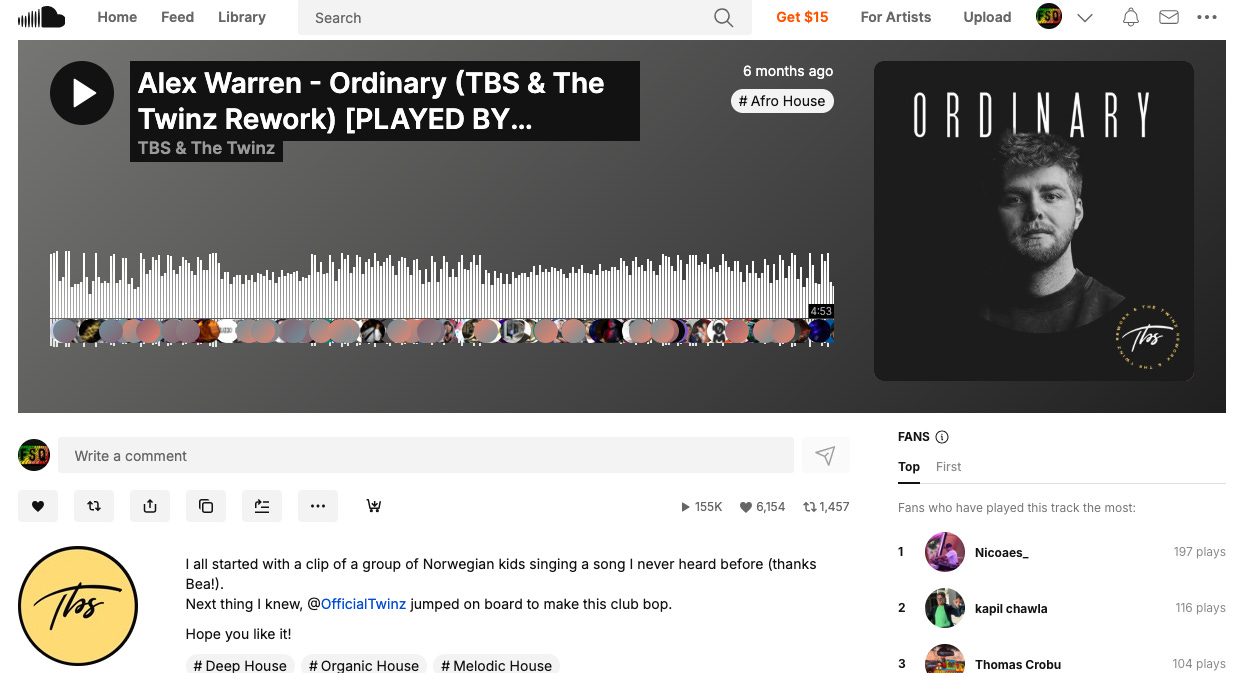
Yet on SoundCloud there are dozens of unofficial remixes of the track, across many genres including melodic house, EDM, nu-disco, house, dubstep, afro house and more. A DJ can pick the genre version of “Ordinary” that would work well for their audience. The most popular of these unofficial remixes of “Ordinary” is from TBS & The Twinz Rework who are marketing their remix with the title “Played by Keinemusik” as a hook to get people to pay attention. This TBS & The Twinz rework of “Ordinary” is indeed quite catchy so whether the popular electronic music crew Keinemusik actually played and supported the track or not might be relevant and on SoundCloud their remix has hit almost 200,000 streams as of June 2026. Though it should be noted, 200,000 streams is hardly anything compared to the almost two billion streams of the original song “Ordinary”. TBS & The Twinz Rework is titled a “rework” versus a “remix” because there are additional new vocals that lead this new song beyond just using the original vocals from Alex Warren. TBS & The Twinz used additional vocals from the Oslo Soul Children choir, who covered the song in a popular TikTok reel. Then TBS & The Twinz picked those vocals up and added them to their new version of “Ordinary”.
AI stem creation tools now allow remix producers to break down the components of an original song to be used to create an unofficial remix. With such technology, the speed at which unofficial remixes can be generated is faster than ever before. Often producers use these unofficial remixes they’ve produced to gain followers on SoundCloud, Spotify and Instagram using music focused social unlock tools like Hypeddit and Feature.fm which exchange a free download of the unofficial remixes in trade for a social follow on those platforms. Furthermore, Hypeddit offers top charts of the most streamed and most downloaded tracks offered on its site, so remix producers with unofficial remixes can show off that they are at the top of their game by dominating the overall Hypeddit chart, or within a specific Electronic / Dance music genre chart on Hypeddit. Some remix producers hope the chart action leads them to get the attention of the artist / label so that they can get their remix sanctioned.
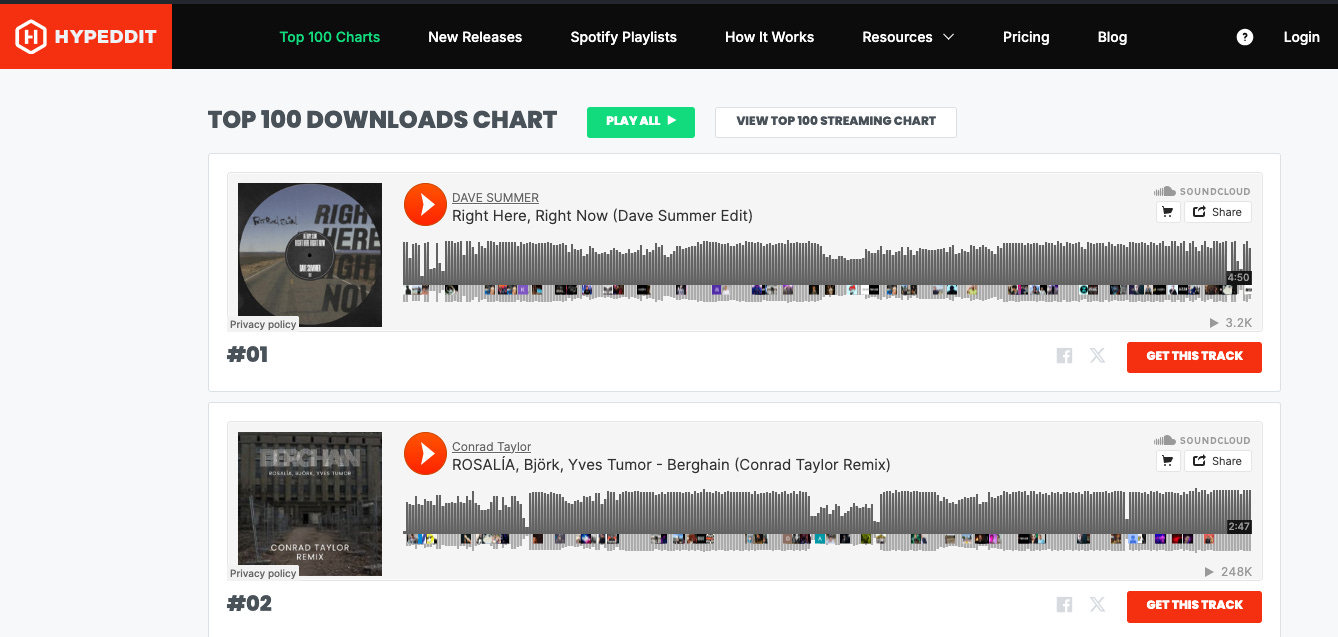
DJ / Producer Conrad Taylor’s Unofficial remix of ROSALIA’s “Berghain” racked up almost 250,000 streams and thousands of downloads and given its popularity, the artist hoped Sony Music would make his remix official and available on music services. It was #2 on the “Most Downloaded” techno chart on Hypeddit. Yet the remix was so popular, someone distributed it illegally to DSPs which reflects the risks of not being able to copyright protect a remix work that is already infringing on the rights of the original artist. Taylor describes his unofficial remix saga with ROSALIA’s “Berghain” here in this Instagram reel.
When this series was originally published in November of 2025, Taylor’s remix of ROSALIA’s “Berghain” and TBS & The Twinz rework of “Ordinary” were both unofficial. Sony Music released both in 2026, in March and April respectively. Now that it’s official, Taylor’s remix of ROSALIA’s “Berghain” has racked up almost 12 million streams as of June 2026. So this is a great example of how speedily a popular unofficial remix can become official through the power of social media, fan engagement, and club play.
Why release Official Remixes?
Unlike these unofficial remixes, official remixes are NOT meant to be easy bait to gain followers on social media sites, nor are they meant to be easily accessible tools for the DJ trying to reach popular music fans with quick and dirty, low quality club versions of big pop hits. The time and money investment that goes into making and marketing official remixes can vary, but the goal is to get them on to streaming services and at music retail platforms so that they generate revenue and of course delight listeners. And a sought after remix can sell vinyl if the label presses a remix package. Often two Electronic / Dance music artists can find an easy route to collaborate with each other through official remixes versus creating new original tracks together.
Many official remixes serve to push original tracks into other genre territories so that they can serve audiences who favor genres other than the primary genre of the original artist. DJs might want to play the track but fit it in a set that is stylistically apart from the original track, closer to their own overall sound. If the original track was a deep house tune, a Nu-disco remix version might be appealing for dance focused parties, or a minimal / tech version would do better in a more underground club. A remix can help an original track chart on a genre chart for which it wouldn’t normally have been eligible.
Remixes are becoming a big lever for major labels to market and monetize their large back catalogs. Universal Music of late has been making original stems from their Motown catalog available for specific influential DJs and producers to make remixes that are then officially distributed. Vandelux’s remix of Marvin Gaye and Tammi Terrell’s “Ain’t No Mountain High Enough” is one example from that catalog. In 2024, when Universal Music released a previously unreleased James Brown track called “We’ve Got to Change” the label sought out remixers to make the song more relevant to today’s market, including one by Peloton DJ John Michael. Before the wave of official remixes based on catalog music began, in the early 2010s, there was an elite group of producers who were able to get session files of classic recordings and make unofficial remixes. Los Angeles-based producer Luxxury was famous for his remixes based on original session files and was the subject of a Wall Street Journal profile titled “New Remixes Flower From Old Song Stems”. After the profile was published, Warner Music Group moved to take down Luxxury’s most popular remix, which was of the Eagles’ “Hotel California.” So over the past decade, major labels have really warmed up to remixes of classics and deeper into the back catalogs. It’s incredible to see this change in the market.
Official remixes can extend the life of a newly released song in the music market. Music catalog company, Duetti, is focused on buying songs that are 24 months to 6 months old and finding remix opportunities for them. The company is hiring independent artists to then remix 30,000 tracks from their growing catalogue and will then distribute the remixes and give the remix artists a share of the revenue. In 2025, Music catalog giant Epidemic Sound announced a program called “Extra Version” where they would pay DJs and producers in five- and six-figure sums to dig through their catalog of more than 250,000 songs, stems, samples, and loops to rework those elements into entirely new tracks.
For independent record labels in the world of Electronic / Dance, remixing is usually part of the release strategy to extend the life of a song. For instance, an original track gets a good volume of streams, downloads, radio and club play and is charting at DJ retail sites upon its release. Then 6-12 months after a track finds some success, official remixes are released giving the track a second chance to pop again and get new editorial coverage.
At Soul Clap Records, we released the London based duo 2fox and their track “Elevation (featuring Laville)” on May 17th of 2024. It hit #1 on the Soulful House chart at the DJ retail site Traxsource, and by October of 2024 it was selected as the #2 best track at the Amsterdam Dance Event (ADE) also by Traxsource. What pushed it over the line at ADE was a remix of “Elevation” by house music legend Louie Vega. While the Louie Vega remix of “Elevation” was not yet officially released at that time, it was in the hands of some major DJs who were performing at ADE. These DJs played the track and brought awareness to the original, which allowed the original to get another chart bump 5 months after its initial release, now appearing on this ADE chart. Meanwhile, the Louie Vega remix did see an official release until May 2nd, 2025 - almost a year after the original release. The track again wound up on the charts and on the radio, this time as the Louie Vega remix, with spins of the track across several BBC Radio channels.
Conclusion and Part 2 preview: How music services struggle with remixes
In part one of this series, “Electronic / Dance: A Guide To Remixes on Streaming Services and at Retail Music Platforms” I demonstrated that 30 to 50% of the consumption of the Electronic / Dance genre (the 6th largest genre in the US) is being driven by “Official Remixes” on streaming services and at music retail.
I defined what separates an “Official Remix” from an unofficial one and why unsanctioned remixes on Soundcloud or Bandcamp can still help grow the original track. Through remixes, producers can turn pop hits into club bangers. My argument is that remixes are central to how Electronic / Dance travels. It’s an easy way to collaborate, it’s a route to new audiences and charts for a song, and a good remix buys a released track a second life. Now the larger music industry is catching on to the “Remix Culture” of Electronic / Dance and hopes to benefit from it by allowing AI-generated fan remixes, as we see with the Universal Music Group and Spotify deal.
Despite remixes making up a huge part of the Electronic / Dance genre, the music streaming services and retail sites are having a hard time keeping up with the complexities that arise with delivering a remix to both an artist’s original profile and the remixer’s profile within the DSPs. The rules are different at each music streaming service in terms of how a remix is marketed to new listeners and fans, including display and search options. Music service subscribers may be missing out on their favorite remix producers’ new remix because of such issues.
In the next part of the series, “Electronic / Dance: A Guide To Remixes on Streaming Services and at Retail Music Platforms” I detail the difficulties the streaming services and music retail sites have with marketing and merchandising “Official Remixes”. In Part 2, you will learn the nuances between Apple Music, Spotify, YouTube Music, and other DSPs in terms of how “Official Remixes” are presented to subscribers and listeners. I will detail how some of the nuances are due to the rules specific DSPs have when it comes to how they view and handle “Official Remixes” while other Issues are more technical and have to deal with music metadata. For remix producers, artists, and labels, I will reveal some of the workarounds to better help you get your remixes in front of new listeners and fans.
Finally, for those who either love Electronic / Dance or are producing music in the genre, I produced a scorecard ranking of how well each of the DSPs and music retail sites are marketing and merchandising remixes, based on the services and sites’ features and how friendly they are to “Official Remixes”. Some remix producers, artists, and labels might find the scorecard offered in Part 2 to be a useful tool in terms of where they should be focusing their marketing efforts; for instance, which DSPs will give their “Official Remixes” greater reach?
Again, I encourage you to take the following survey. If you have a vested interest in how remixes are merchandised and marketed in the world of music retail and streaming, please feel free to take the following survey. The results will be revealed in part 3 of the series.