

There’s some concern in the world of luxury goods. After 15 years of steady to rapid growth, there’s now a decline. It started in 2024 and the geopolitical upheavals of 2025 have continued it. Yet, as analysts Claudia D’Arpizio and Federica Levato show, experiential goods outperform most segments in the luxury goods market. They mention rising hotel occupancy rates, curated food offerings, personalized experiences and more. Music, of course, has a strong connection to luxury goods. Just think about music on the catwalk. When done well, the experience blends into one.
There’s a positive upside to the report by Claudia and Federica:
“Over the next five years, more than 300 million new consumers – over half of these in Generation Z or Generation Alpha – are expected to enter the market. Rising global incomes, generational wealth transfers, and a projected 20% increase in the number of high-net-worth individuals will further expand the pool of potential luxury buyers.”
However:
“…realizing the potential growth of this expanding market will require action from the industry’s players. Brands will need to rethink how they engage younger consumers, avoid over-reliance on top spenders, and build emotional connections that go beyond transactional loyalty.”
Is luxury for the superfan?
This all sounds very similar to the ‘superfan’ narratives of the past two years. One way to capture this ‘superfandom’ is to create higher streaming tiers. At this point it’s good to remember that it was the likes of the major labels who pushed for all-you-can-eat packages in the early 2000s through the likes of PressPlay as a response to pirating. It’s just that this $9.99 never moved until very recently.
Back in 2016, Cherie Hu already wrote about the need to diversify streaming subscriptions.
“While it seems that an inflexible dichotomy still persists between people who are and aren't willing to pay for music, the real issue is that there simply aren't enough options. One can either buy an album for $9.99, subscribe to Spotify for $9.99 per month to listen to the album, or pirate the album for free—with nearly no alternative prices in between.”
Instead of thinking about the range between 0 and 10, the thinking in 2025 is about the range above 10. Instead of moving listeners from paying 0 to something, it’s about milking what are called superfans to paying more than 10. In March of this year, Lucian Grange, CEO of UMG, said all this talk about super-premium offerings on DSPs is about the need “to segment and capture customer value at higher than ever levels.” On the one hand, then, this is simply about capturing people’s willingnes to pay. On the other hand, this shows a movement towards seeing music as a luxury good - a reflection through value of its importance to people.
Music as luxury
Luxury goods are all about self-identity, status, symbols, and rituals. All of this comes back into music and the way we, as listeners, can engage with it. This isn’t about fast moving music goods or laidback listening. Here, music takes a different shape. We can begin to think of merch and the self-identifying nature of it. While writing this, I’m wearing a band shirt (Divide and Dissolve) and if I walk around in it, it’s basically a request for communication and showing off status. When we think about music as luxury, however, I think we need to take it further than a t-shirt or mug.
Music as luxury needs to dig into the luxury mindset that draws people to specific brands. This isn’t unknown to music - fans are drawn to Taylor Swift, Nirvana, etc. They’re also already happy to express this fandom. Experiential goods are also commonplace in music, just think of the live experience and everything that comes with it. A lot of what luxury goods do is to sell not just a premium product, but to sell the idea of an elite lifestyle. Music can use this and invert it. This isn’t just about the major brands in music - Taylor, Rihanna, Ariana, Beyoncé and co - but also about every other artist.
Music as luxury media
Remember that the current trend in luxury goods focuses on the experiential. Add to that, that fandom expresses not just self-identity, but also self-discovery. Fans don’t simply identify with their favourite artist, they find themselves in this life. This self-discovery leads to social enhancement as one’s identity integrates with a group. Taking all this into account, music as luxury becomes music as luxury media. In essence, music becomes a container - not too different from a Rolex or a Louis Vuitton bag.
Music as luxury media can be externalized. In the true sense of the expression of a self-identity, music can be worn as a personalized experience. Here, we can imagine music as an ‘always present’ form of expression and interaction. During the NFT hype, one form was to include NFC tags in clothing. Brands like Burberry are doing some interesting things to develop this. Everything still revolves around the in-store experience. However, it starts before the visit. The customer gets sent a virtual clothes collection which they can appraise and select from. This selection will then be waiting for them in the store when they have their appointment. The bought garments then include an RFID (radio frequency identification) tag which allows Burberry to send communication directly to the customer’s phone. Think styling suggestions and the like. For music, these can become hyper personalized suggestions for gigs, playlists, etc.
Music as luxury media can also take on a much more intimate and internalized form. This isn’t so much about expression of self-identity in a group or social setting. Instead, this is much more about integrating the fandom aspect into the artistic process. The luxury watch brand Roger Dubois recently partnered with Pirelli to offer supercar owners the chance to race on famous tracks around the world. This is niche, but it works because it’s an experience rarely available otherwise. Perhaps it’s even something money can’t buy. In music, this can revolve around ideas such as Sound of Fractures’ funding the experiment and not the outcome. Think: “new funding models that don't have specific outputs, that allow creators and artists to explore, to play and experiment without pressure.”
The luxury media element is a true container here. Anything can fit in it, and it’s mostly about the road to get there, the experiment. This also offers a one-of-a-kind experience for whoever pays for it. Similarly, Future Merch sees Forrest Mortifee and Jade Garcia think about merch as a signifier for the future instead of an artifact of a past event.
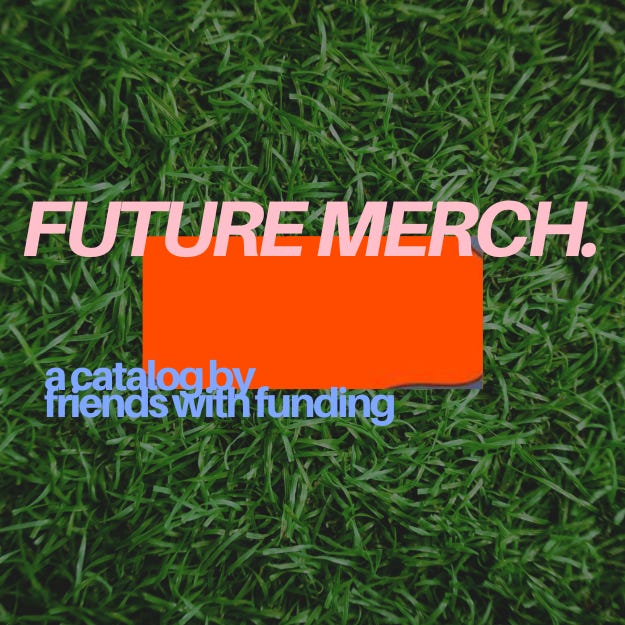
What the fan buys here is a way into the story of artistic creation from an artist they love and appreciate. This moves the conversation around a dinner table of festival picnic rug from talking about a record, t-shirt, or live show to how the fan has been involved in artwork, music video production, mastering, and more. Music is the medium of connection, as always, it’s just that the container fills up with different experiences.
This is what music as luxury media offers. It opens up a completely different value proposition. One that gets determined by the artist and the fan alike. More than any DSPs super premium offer, this radically shifts the value creation model.
LINKS
☔ The end of trends (Emily Segal)
“Trends have become temporary inefficiencies – spikes in value bound for correction. “Being early” is giving way to catching people off-sides or betting on a return to the mean.”
✘ I always appreciate Emily and Nemesis their takes on the world around us. This is a great talk that shows us how the current mode of trends makes it difficult to forecast anything.
🍂 So... when will change come? (Darren Hemmings)
“So, as that rate of change slows, so it means that the path to something new and interesting, one that will speed up the cycle of culture, of fashion, of trends themselves, will take longer than ever to traverse.”
✘ I feel this speaks to my piece above. One reason to think about music as luxury media is because it paves the road to create new cycles of culture.
🪄 What the hexx is DDEX? (Paul S’Jacob)
“If you’re a label wanting to schedule releases and send metadata to DSPs then ERN, MEAD and PIE are for you. If you’re a publisher wanting to send enhanced metadata to DSPs, pick the MWDR suite. The great thing about DDEX is that it’s modular, so you can use as little or as much as you need.”
✘ Bookmark this as your go-to explainer on everything DDEX.
🌑 The hidden world beneath the shadows of YouTube's algorithm (Thomas Germain)
“The YouTube we talk about – the one full of celebrities, scandals and manufactured virality – only tells part of the story. The majority exists in quiet moments, in shaky camera work and voices meant for no one in particular. I watched hundreds of these videos. Everything one of them is public, but it's also clear that most people didn't upload this content for strangers. It was like being let in on a secret, a sprawling, uncurated documentary of human life.”
✘ This is a wonderful insight into how algorithms determine not just what we see but also what we think of the medium that we consume through. There’s way more content than we know of. There’s also a different story behind each piece of video that exists on YouTube.
👂🏿 The Technosonic of Black Expressionism (Reg Zehner)
“The Black Expressionism of Technosonic is a path forward, an understanding of Black emotional present and futurisms that escape and redefine the Eurocentric languages of personhood. It is born over and over again in the same vein of spaces – poor Black communities that rely on the interconnectivity of their creativity and love of creation. You can find the sounds on the radio, in your neighborhood, on the buried Youtube videos or the record store on the brink of closure. The sounds are the night clubs, the bass structurally holding the social presence in the room. Its resistance rings out in the night, slowly becoming the shadows and echoes of the day, once the sun arrives.”
✘ This is such a great piece, and I realised that I had never featured it before in MUSIC x. I’m rectifying that now. I reread it a few weeks ago and it remains not just a strong piece, but also a wealth of great music recommendations.
MUSIC
Can music really be political? Or, is music always political? These are tough questions that almost immediately take us into the gray zone. One artist who has spun their own take on this is Terre Thaemlitz in her recent RA1000 mix. In this mix, music isn’t an escape but also a document of suffering. Through it, Terre searches for something beyond escape, beyond politics and towards the human.
I always read these with interest, but increasingly the funnel model, + the "superfan" strategy seems to boil down to "Start A Cult". Leaving aside the other hazardous dimensions to that idea, it feels like there's a...general waning of available fervor to be courted, across multiple cultures and societies. A large majority of people just don't have the extra bandwidth, let alone the finances, to make these strategies work for more than 1-2% of artists even briefly now.
Very interesting, thoughtful article.
Some extremely pedestrian thoughts on how lack ‘software’ hurts the evolution of music as luxury experience:
A fashion show not only has professional equipment and a hired DJ, but the DJ is using professional software which, among other things, has robust queue management and accidental music changes prevention features.
The +800 million DPS users have no such luxury (sorry about the pun) of controlling their queues, nor protecting the music flow from completely crashing by one single wrong click on a touchscreen.
Boutique hotels may use software from music consultancies, chains may use B2B DSPs. They have tools to control multiple ambients playing different music. Specific playlists can be scheduled for different times of the day. DSP users can only control one ambient, and only program the immediate future.
Sonos is one of the few major brands that provide multiform support. Roon Server, acquired by Harman, remains very niche.
To play songs with some kind of background video or slideshow, users often resort to those hours-long song mix videos uploaded by users on Youtube.
There can be many excellent, high-value DJ mixes, setlists etc. available online, but they are scattered over Soundcloud, Youtube, Mixcloud(?) and even Apple Music.
Bluetooth connections remain limited and fickle.
Smart speakers often don’t interact well with many DSPs (Alexa vs Apple Music; Spotify vs HomePod etc.)
Spotify Connect often works well, but Spotify sound quality is the opposite of luxury.
If only there was some premium service that could address these kind of hurdles in a comprehensive fashion...